Why Are Some Examples of Prehistoric Art in France and Spain So Well Preserved
Art has been effectually since the dawn of fourth dimension; prehistoric cave paintings can be found in grottos and on cliffs around the earth. However, intact prehistoric sculpture remains a rare find for archeologists, though not impossible. And when discovered, they provide a fascinating insight into the lives of the earliest cultures. In southwest France, a system of three large caves adjacent to the River Volp present some of the finest examples of Paleolithic art in Europe. Among the wonders of the caves is a small, complex sculpture of 2 bison sculpted in clay. This artwork dates back to about 13,000 BCE and offers a mysterious clue to scholars interested in early Magdalenian culture.
The River Volp flows through the foothills of the Pyrenees Mountains range which separates France and Espana. Near the commune of Montesquieu-Avantès in southwestern France, the river flows under rocks for some length. The river actually disappears into caves, which were offset explored in 1912 past Henri Bégouën and his three teenage sons. The system of caverns is technically iii split up caves, merely 2 of which are connected. Called Trois-Frères (three brothers), Enlène, and Tuc d'Audoubert, the three caves comprise 3 levels. The river flows through the everyman, while the other levels host rooms of varying sizes. It was within Tuc d'Audoubert that the young men encountered cavern walls engraved and painted with paleolithic fine art. Under the management of a family unit friend and archeologist, Émile Cartailhac, the caves began to be researched to encounter what other treasures they might concord.
Careful exploration of the caves turned up hundreds of examples of artwork by the Stone Historic period Magdalenian peoples. These ancient humans were known to hunt reindeer, horses, and other large game during the waning of the Water ice Age. Their ancient living and ritual sites have been institute in France and Espana and include cave fine art, engraved bones, and other artifacts. The findings at the three caves added to the repertoire of ancient art attributed to the culture. In the Enlène cave, os and ivory fragments carved with animal depictions were discovered. The craftsman chose to describe a equus caballus's head on a hyoid bone of a equus caballus; a chamois (a goat-antelope animate being native to the region) is also carved on the mandible os of a bison.
The Enlène cave contained relatively few examples of wall fine art; however, the other two caves provide rich engraved and painted examples. At Tuc d'Audoubert cave, abstract guild symbols (claviforms) shaped like the letter "P" were repeated often, especially in a room which came to be known as the Gallery of the Claviforms. Throughout the cave, 103 animals are depicted on the walls and floors. These include horses, reindeer, and large cats. Withal, the bison seems to take been the most revered of these animals—composing a total of forty per centum of the animal depictions. In addition, 250 abstract signs and other mysterious figures take been documented by researchers returning to the cave over the decades since its discovery.
Some of the mysterious figures shown on the walls have absorbed scholarly interest while their meanings remain elusive. Known as "the magician," a painting of an creature hybrid walking upright with horns is ane of the most famous examples of the art within the cave system. Institute in the Trois-Frères cave, the design was initially recorded by Henri Breuil. He sketched what appears to be a man-animate being mystical figure. Hence, the painting received the name "the sorcerer" every bit Breuil believed the design indicated a magical effigy or magician. Theories grow every bit to the identity and importance of this figure. Given the big game depicted elsewhere on the walls, perhaps the figure was a lucky symbol for a successful hunt. Perhaps it is some mythical king of the beasts. In its unusual grade and prominent position, scholars feel sure that "the sorcerer" must be an important part of Magdalenian culture and relate to the use of the caves.
Perhaps the most exciting discovery of the caverns is a small clay statue in the deepest room of the Tuc d'Audoubert cavern—at present known equally the Room of the Bisons. Supported by a rock in the flooring of the cavern is a small clay statue of two bison sculpted in relief. The work is just about 18 inches alpine but remarkable for the detail with which it depicts a male person and female person bison who appear to be close to mating. Thier very realistic appearance was created using a combination of hand and tool. The clay used was clearly carved from the wall of an adjoining cavern. Despite the almost xv,000 years which have passed since its creation, the sculpture is even so in generally good condition. This is in function due to the restricted admission policy—since almost the day of its discovery—which just allows researchers to enter the caves.
While the beauty of the prehistoric bison statue is undeniable, its meaning and importance to the original inhabitants of the caves is murky. Experts suspect the bison statue had a ritualistic purpose like much of the other cave art. Certainly, bison were an of import food source, and their bones are found among the other artifacts of the caves. Many representations of the beasts were found throughout including one carved on the flooring near the clay statue. It seems these large beasts held an important place in Magdalenian civilisation.
The world of the Magdalenians who inhabited the iii caves along the River Volp remains partially shrouded in the thousands of years which stretch between their lives and modern researchers. Modern science tin clarify the genetics of these early humans, and archeologists can document the cave art they leave behind. Even so, the lives that correspond to the footprints—adults and children—which all the same lay lightly impressed in clay effectually the cave floors remain an object of fascination, investigation, and speculation.
In three caves along the River Volp in French republic, hundreds of examples of Paleolithic art by the Magdalenian people were discovered in the early on 20th century.
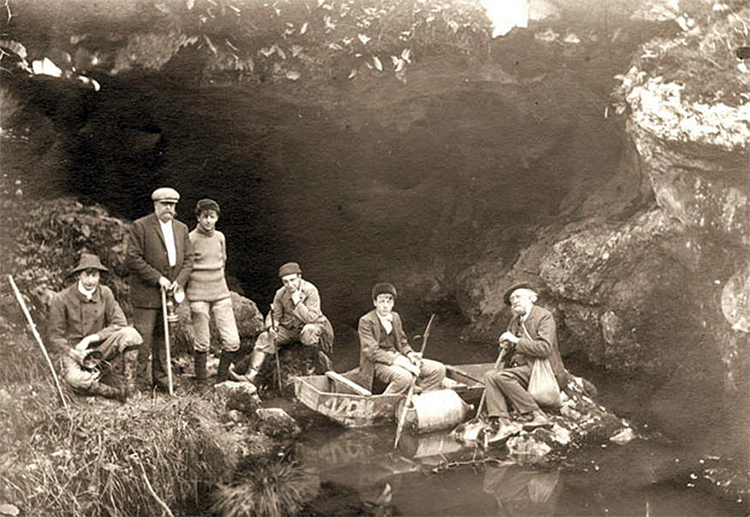
Henri Breuil, Émile Cartailhac, and Henri Bégouën and his sons in front of the archway to the Cave of Tuc d'Audoubert in July 1912. (Photo: Wikimedia Commons [Public domain])
This fine art includes a small, intricate statue of 2 bison—a stunning and rare case of Stone Age sculpture.
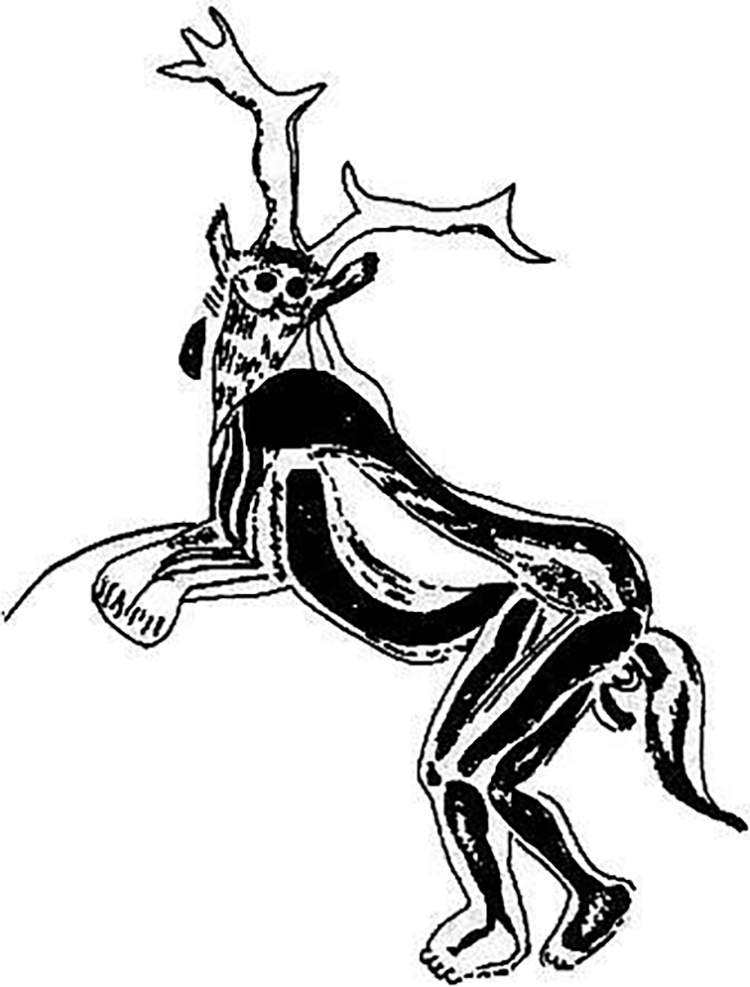
A cave painting within the Cave of the Trois-Frères (Three Brothers), originally dubbed "the Sorcerer." The in a higher place cartoon is based on the original sketches of Henri Breuil. (Photo: Wikimedia Commons [Public domain])
Much of the meaning behind the cave art remains a mystery, simply it is a window into the lives of early on humans xv,000 years ago.
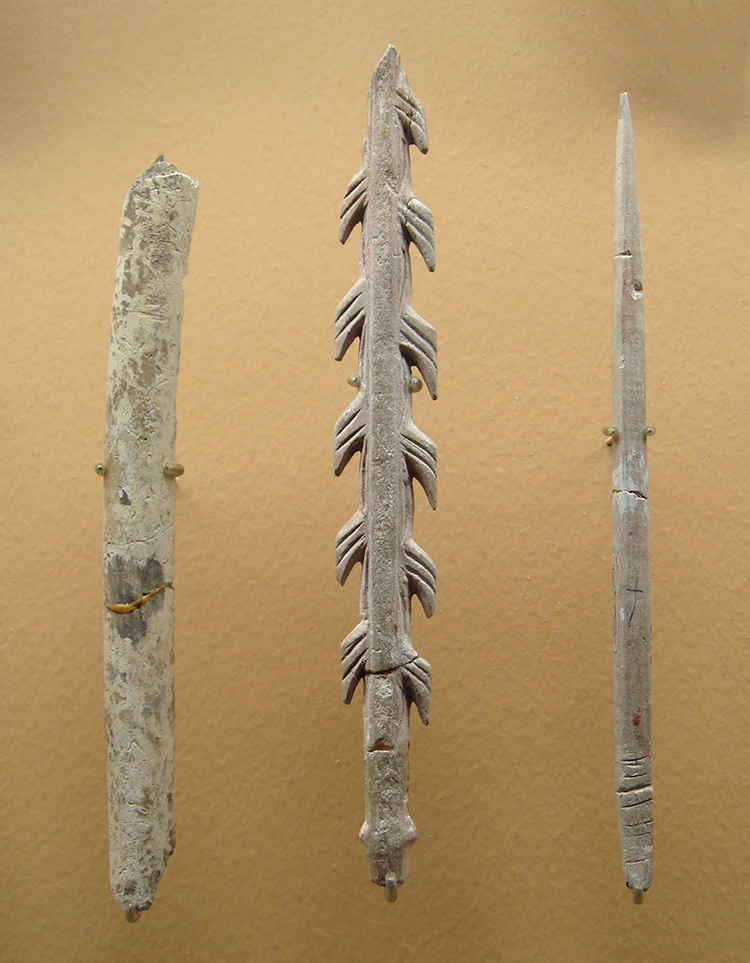
Magdalenian tools dating from between 17,000 and 9,000 BCE. Institute in Abri de la Madeleine, Dordogne, French republic. (Photograph: World Imaging via Wikimedia Commons [CC By-SA iii.0])
Related Articles:
"Sistine Chapel of the Ancients": Researchers Discover Thousands of Ice Historic period Rock Paintings in the Amazon
6 Incredible Facts Virtually the Prehistoric Altamira Cave Paintings
Discovery of a nine,000 Twelvemonth-Old Burial of a Female Hunter Challenges Prehistoric Gender Roles
This 45,000-Year-Quondam Warty Pig Cavern Painting May Be the Oldest Known Animal Art
Source: https://mymodernmet.com/bison-sculpture-tuc-daudoubert/
Belum ada Komentar untuk "Why Are Some Examples of Prehistoric Art in France and Spain So Well Preserved"
Posting Komentar