When do babies sit up by themselves, and what can we do to help them?

Most babies learn to sit up by themselves quondam between 4 and 8 months. Just the process is gradual, and some babies make faster progress than others. We tin give motor development a boost by helping babies build key muscles.
When practice babies sit upwardly by themselves? There isn't any one, universal reply.
Around the globe, approximately half of all babies have learned to sit independently by the historic period of vi months. But some babies reach this milestone much before — every bit early on as 4 months. And other babies take much longer — 8 months or more.
Why does the timing vary so much?
To some degree, the timing depends on genetics.
For example, some babies might exist born with a genetic tendency to exist more physically agile. Equally a effect, they get more exercise, and this helps them learn new motor skills at a raster step.
But it's also evident that the environs matters. Quite a lot!
For instance, in a study of infants living in the United kingdom of great britain and northern ireland, researchers establish that approximately half the variation in the timing of sitting was caused by differences in the environment. Some children were growing upwardly in environments that favored before development (Smith et al 2017).
And then what'south considered normal? When should a parent be concerned about the possibility of a developmental delay?
Experts offer this dominion of thumb: If your baby hasn't begun to sit down upwards by the age of 9 months, talk to your doctor. Your doctor tin screen your infant for issues. If something's not right, early intervention will help your baby get back on rails.
Just at that place'southward goose egg magical near 9 months. If you lot see something that bothers yous — if something seems off — you shouldn't wait until nine months. Particularly if your baby is budgeted the 9 calendar month marking and seems to accept problem sitting with back up. Trust your instincts and consult your medico.
And if your baby is older than 9 months? That doesn't mean your baby has a developmental trouble. For many infants, taking longer is just a reflection of their personal quirks and experiences. As we'll see beneath, babies learn to sit upwardly earlier when they get more opportunities to practice. And we can do a great deal to aid them.
And so why the focus on 9 months? And where do these other numbers come up from? How do we know what's typical or normal?
Ultimately, the numbers come from scientific surveys. Researchers recruit families with immature infants, and rails development over time. Parents report when their babies reach certain motor milestones.
For case, in one study, the Globe Health Organisation tracked more 1,100 babies in half-dozen unlike countries.
Every month, researchers asked parents about their infants' motor development. And after all the data were collected, researchers found that approximately 95% of the babies had learned to sit up (unassisted) erstwhile betwixt the ages of 4.3 months and eight months. Almost half of all babies in the written report had learned to sit upwardly independently past the age of five.ix months (Matorell et al 2006).
Then it's numbers like these that experts employ to make generalizations about what to expect. They aren't numbers that tell us what "should" happen. They are numbers that tell us what actually happened…among babies participating in a specific study.
And here's what's interesting: We tin can go very different numbers depending on where nosotros look.
The "normal" or "typical" age range for sitting up isn't the same in every county. It varies. Sometimes pretty dramatically. And the variation maps onto what nosotros know well-nigh local parenting practices.
To run across what I mean, consider the West African state of Ghana.
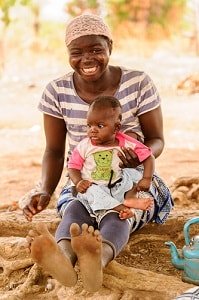
Paradigm of Ghanaian mother and baby by Anton Ivanov
In Republic of ghana, parents don't expect passively for their babies to experiment with new motor skills!
Similar parents in many other African and Caribbean countries, they actively train their babies. For example, caregivers utilize their hands and supportive objects to help young infants do sitting in an upright position (Adolf et al 2010; Karasik et al 2015). And the outcome?
In Ghana, the average (mean) age for learning to sit up independently is approximately 5.1 months. Around 95% of babies in Ghana achieve the milestone between the ages of 3.v and half-dozen.7 months.
By contrast, let's take a await at a country in Northern Europe — Norway. Parents in Norway commonly accept a more "wait and see" approach to physical development. They don't coach their children to sit upright, and the outcomes are quite different:
In the World Health Arrangement study, the average Norwegian infant didn't begin sitting upwardly independently until about 7 months. And roughly ane-3rd of babies didn't reach the milestone until they were at least 8 months quondam (Matorell et al 2006).
So if we used data from Ghana to evaluate Norwegian babies, nosotros might think that Norway is plagued past developmental bug. Ane tertiary of Norwegian babies are and so slow they fall outside what nosotros might call the "normal range of variation" in Republic of ghana.
But are these babies suffering from a medical condition? Are they challenged by a disease, or a physical inability, or a cognitive disorder?
In most cases, no. They're just taking longer — most probable because they haven't had the same opportunities to practise and develop their motor skills.
How, and then, can you boost babe motor development? How can you lot assist your baby larn to sit down up?
The primal is to provide your baby with the right sort of concrete activities — activities that recognize your baby's electric current limitations, just also encourage your baby to push those limits.
Where to brainstorm? It's helpful to understand the basic challenge that babies face.
To sit upright, babies need to something called "trunk control." They need to build forcefulness in core muscles throughout the neck, torso, and spinal column. And they develop this force 1 segment at a time, in a specific, "tiptop-down" sequence (Pin et al 2019):
- Beginning, they build strength in their neck muscles.
- Next, they brainstorm developing stronger muscles in the upper (thoracic) region of the body.
- Then — once they've adult a strong thoracic region — they start building up the muscles of the lower trunk (the lumbar region).
Many parents seem to accept an intuition about this sequence. Yous tin can see it when they agree their babies upright.
When a baby is very young and weak, parents typically concord onto the baby at the shoulders. But as the baby gets stronger, parents hold onto the upper or mid-dorsum. And when a baby is nigh fix to sit upward unsupported, parents place their hands around the lower back or hips.
So if yous pay attention to your babe's wobbles, you'll quickly get a feeling for where your baby is in the sequence. You'll have a sense of which muscles are already strong, and which muscles need conditioning.
Here are some things you can do at each stage of the process.
Six tips for educational activity babies to sit upright
i. Help your baby develop stiff neck muscles with "tummy time."

Safety experts urge us to place young infants on their backs for sleeping. This tactic reduces the risk of SIDS. Merely when babies are awake and warning, they benefit from supervised sessions on their stomachs — especially if their caregivers make information technology a fun, social experience.
Such "tum time" can speed up the development of certain locomotor skills, like crawling. And because tummy time gives babies the opportunity to develop greater muscle control and neck strength, it may assistance babies gear up for sitting upward by themselves (Kuo et al 2008; Hewitt et al 2020).
Does your baby dislike being placed on the floor? As an culling, try lying down and place your babe on your chest.
2. Help your baby strengthen core muscles of the trunk with more stomach fourth dimension, and with opportunities to roll around.

Rolling over is another i of those motor milestones that tin can vary a lot in timing: Some babies tin do information technology before 3 months. Others may accept half dozen months.
But whenever it happens, it's a big footstep in the direction of beingness ready to sit up. That'southward because rolling around builds the potent, core muscles that babies need to stabilize themselves in an upright position.
three. Give your baby a taste of what it feels like to sit upwards. Become a living chair.

This is a common technique in cultures where parents accept a proactive approach to motor development (Adolph et al 2010). Newborns aren't but cradled and carried. They are also placed upright, in a sitting position, on their caregivers' laps. The adult holds the babe in place, and becomes a kind of living chair — i that the baby tin lean against.
four. Is your baby potent enough to hold up his or her own head? And able to keep the upper back region vertical and steady? Then your baby may be ready to attempt brief, supervised sessions of supported sitting on the floor.

Want to follow some other cue from "proactive" cultures? Try seating your baby on the ground, with furniture, cushions, or other props to keep your infant from toppling over (Karasik et al 2015).
If you effort this, your baby should already take strong neck muscles, and you should have noticed that your baby is starting time to develop command in the upper thoracic region (run across above).
Also, remember not to get out your baby alone. This is something you and your baby will be doing together. And when you first begin these sessions, they will be very brief.
Your baby is learning to cope with gravity, learning how to counteract every little tug and tilt. Staying upright requires instantaneous adjustments in the stiffness of many different muscles. Information technology's quite a trick!
So when your baby moves away from his or her supports, it's no wonder if your baby can only stay upright for a few seconds at a fourth dimension. Just those moments — however fleeting — are long enough to make a difference. With practice and exercise, your baby will develop more forcefulness in the muscles of the thoracic and lumbar regions, and be capable of longer bouts of supported sitting.
v. Watch for "tripod sitting" — an early stage of sitting up where babies utilise their arms to prop themselves upwardly.

Now "tummy time" is better termed "floor time," considering your baby is capable of sitting upwardly by him or herself — at least for cursory periods of time. At outset, your babe's stance will probably look rather bent or hunched forrad , and your infant may require both hands on the footing to stay upright.
Simply your baby volition begin to experiment with lifting i hand, and slowly learn how to adapt his or her residue. You tin encourage this procedure by playing with your baby face-to-face, and offering your baby interesting objects to hold. And this brings us to my concluding proposition…
6. Empathize how your baby's world is changing. Exist ready to provide your babe with new learning opportunities!

Sitting up, unsupported, is more than than a motor milestone. Information technology's too a trigger for new environmental experiences — experiences that can give your kid a cognitive boost.
Once babies can sit down upwards — without having to apply their hands to keep their residual — it'due south easier for them to reach for objects. Information technology's also easier for them to manipulate and visually examine objects, and that helps them learn about objects (Woods and Wilcox 2013).
Information technology'southward also likely that sitting upwards helps babies learn language. Information technology's easier for them to make eye contact, and this tin stimulate more face-to-face conversation with their caregivers. They get exposed to more words, and begin learning new vocabulary at a faster footstep (Libertus and Violi 2016).
And so be ready to provide your baby with the stimulating social and cognitive rewards of sitting. Don't leave your baby alone in chair with nothing to practise. Encourage your infant to investigate, observe, communicate, and learn.
More reading virtually your baby's development
Practice you have other questions nearly your infant's development? Check out these Parenting Science articles:
- opens in a new windowMotor milestones: How practise babies develop during the first ii years?
- opens in a new windowWhen practice babies crawl, and how does itch develop (illustrated guide)
- opens in a new windowWhen practise babies start walking, and how does it develop?
- opens in a new windowWhen exercise babies say their first words?
- opens in a new windowTalking to babies: How eye contact helps infants tune in
References
Adolph KE, Karasik LB, Tamis-LeMonda CS. 2010. Motor skills. In: Bornstein MH, editor. Handbook of cantankerous-cultural evolution scientific discipline. Vol. ane. Domains of evolution across cultures, pp. 61–88 Hillsdale, NJ: Erlbaum.
Gonzalez SL, Alvarez V, Nelson EL. 2019. Do Gross and Fine Motor Skills Differentially Contribute to Language Outcomes? A Systematic Review. Front Psychol. x:2670.
Hewitt Fifty, Kerr Due east, Stanley RM, Okely AD. 2020. Breadbasket Time and Infant Health Outcomes: A Systematic Review. Pediatrics. 145(6):e20192168.
Karasik LB, Tamis-LeMonda CS, Adolph KE, and Bornstein MH. 2015. Places and postures: A cross-cultural comparison of sitting in 5-month-olds. J Cantankerous Cult Psychol. 46(8):1023-1038.
Kuo YL, Liao HF, Chen PC, Hsieh WS, Hwang AW. 2008. The influence of wakeful decumbent positioning on motor development during the early on life. J Dev Behav Pediatr. 29(5):367-76.
Libertus G, and Violi DA. 2016. Sit down to Talk: Relation between Motor Skills and Language Evolution in Infancy. Front Psychol. vii:475.
Martorell R, Onis M, Martines J, Black M, Onyango A, Dewey KG. 2006. WHO motor development report: Windows of achievement for six gross motor development milestones. Acta Paediatrica. 95(S450):86–95.
Oudgenoeg-Paz O, Leseman PP, Volman MC. 2015. Exploration as a mediator of the relation between the attainment of motor milestones and the evolution of spatial knowledge and spatial language. Dev Psychol. 51(9):1241-53.
Oudgenoeg-Paz O, Volman MC, Leseman PP. 2012. Attainment of sitting and walking predicts evolution of productive vocabulary between ages 16 and 28 months. Baby Behav Dev. 35(4):733-half dozen.
Pin TW, Butler PB, Cheung HM, Shum SL. 2019. Human relationship between segmental trunk control and gross motor development in typically developing infants anile from 4 to 12 months: a pilot study. BMC Pediatr. 19(1):425.
Smith L, van Jaarsveld CHM, Llewellyn CH, Fildes A, López Sánchez GF, Wardle J, Fisher A. 2017. Genetic and Environmental Influences on Developmental Milestones and Movement: Results From the Gemini Cohort Study. Res Q Exerc Sport. 88(4):401-407
Valla L, Slinning Grand, Kalleson R, Wentzel-Larsen T, Riiser Yard. 2020. Motor skills and later on communication development in early childhood: Results from a population-based study. Child Care Health Dev. 46(four):407-413.
Valla L, Wentzel-Larsen T, Hofoss D, Slinning Chiliad. 2015. Prevalence of suspected developmental delays in early infancy: results from a regional population-based longitudinal study. BMC Pediatr. 15:215.
Woods RJ and Wilcox T. 2013. Posture support improves object individuation in infants. Developmental Psychology 49(8): 1413–1424.
Saavedra SL, van Donkelaar P, Woollacott MH. 2012. Learning virtually gravity: segmental cess of upright command equally infants develop independent sitting. J Neurophysiol. 108(8):2215-29.
Valla L, Wentzel-Larsen T, Hofoss D, Slinning K. 2015. Prevalence of suspected developmental delays in early infancy: results from a regional population-based longitudinal study. BMC Pediatr. 15:215.
Title image of three babies sitting by Rawpixel / istock
Image of Ghanaian mother and babe by Anton Ivanov / shutterstock
Image of father with infant on floor by FlamingoImages / istock
Epitome of infant rolling over by Gwill / Shutterstock
Image of mother beingness a living chair for infant by RobertoDavid / istock
Image of babe sitting on floor, propped upward on pillows by Sasiistock / istock
image of babe sitting in a tripod opinion by Tracey Newman / istock
Image of female parent with baby in a park by MonkeyBusinessImages / Shutterstock
Content final modified 12/2020
Source: https://parentingscience.com/when-do-babies-sit-up/
Belum ada Komentar untuk "When do babies sit up by themselves, and what can we do to help them?"
Posting Komentar